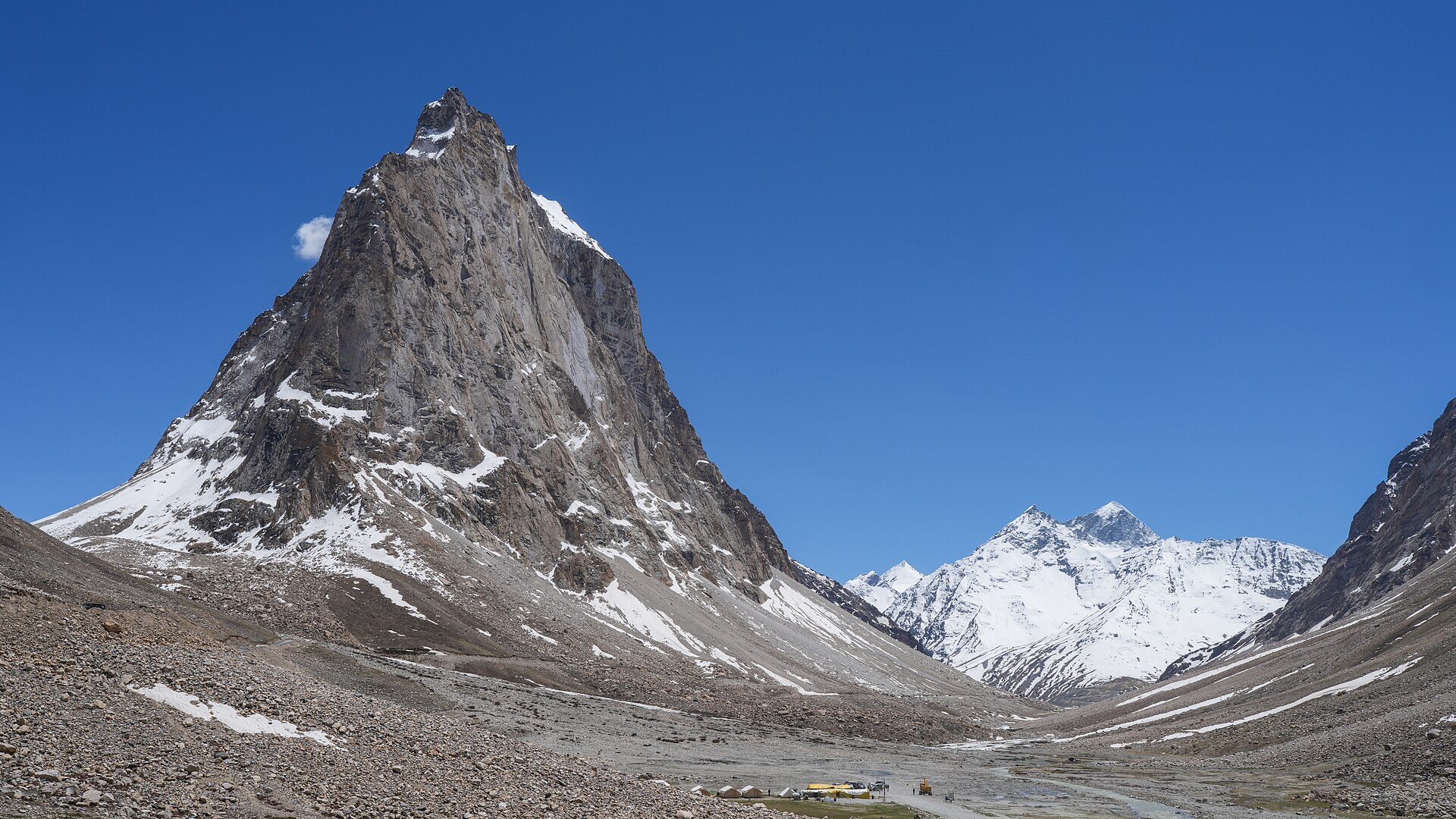
Zanskar sits behind two mountain ranges, and no flight lands inside it. Every journey from Delhi reaches Leh or Kargil first, then continues overland through Kargil to Padum, or over the high passes from Manali. The choice is less about distance than about altitude: how fast you want to climb from Delhi's 230 metres to Padum's 3,850, and whether your legs or your stomach will tolerate a rushed ascent.
Flying Delhi to Leh, then road to Zanskar
This is the fastest route and the one most visitors take. Flights from Delhi to Leh run daily in the May to September season, take roughly 1 hour 20 minutes, and cost between 6,000 and 14,000 rupees one way depending on how far ahead you book. Morning departures are more reliable, since afternoon winds over the Himalaya can delay or cancel later flights. From Leh, the road to Padum via Kargil takes a full day of driving, around 240 km in 8 to 10 hours depending on the state of the Pensi La pass. Most travellers break this into two days, overnighting in Kargil, which also allows a buffer against altitude sickness after the flight. Do not drive to Zanskar the same day you land in Leh: 48 hours of rest at Leh's 3,500 metres is the minimum sensible acclimatisation window before pushing higher.
Flying Delhi to Kargil (seasonal, limited)
Kargil has an airstrip with occasional seasonal flights, usually routed via Srinagar or Jammu rather than direct from Delhi, and schedules change year to year. Check the day's schedule before relying on this option, since frequency is low and flights are sometimes suspended without much notice. For most planning purposes, treat Leh as the only dependable air gateway and Kargil as a bonus if it happens to be running.
The road from Kargil to Padum
Whether you fly into Leh or Srinagar, the final overland leg usually passes through Kargil. The 230 km stretch from Kargil to Padum, much of it now paved, has cut what was once a two-day ordeal down to around 7 to 9 hours of driving, with shared taxis and jeeps available from Kargil town. This new road is also the valley's biggest recent change, bringing supplies, construction material and tourism in equal measure, and reshaping daily life in villages that spent decades reachable only by foot or frozen river. The fuller story of that shift, and what it means for travellers passing through, is covered in Kargil to Padum: the road that changed Zanskar.
Padum sits at roughly 3,850 metres. If you fly into Leh (3,500 m) and drive the next day, you are stacking altitude gain on top of an already high starting point. Spend at least one full rest day in Leh, drink more water than feels necessary, and avoid alcohol for the first 48 hours. Watch for headache, nausea or unusual breathlessness, and delay the onward drive if symptoms appear.
The Manali to Darcha route
An alternative, mostly used by those road-tripping rather than flying, runs from Delhi overland or by flight to Manali (roughly 570 km, 12 to 14 hours by road or a short domestic flight where available), then up through Darcha and over the Shinkun La pass into Zanskar from the south. This route is seasonal, generally open only from mid-June to early October depending on snow clearance, and the final stretch into Padum from the south is rougher than the Kargil approach. It suits travellers who want to combine Zanskar with a longer Himachal and Ladakh loop rather than a direct in-and-out. For a full breakdown of doing the circuit both ways, see the Zanskar road trip: Leh to Padum by both doors.
Shared taxis, private hire and buses
Government and private buses run between Kargil and Padum on a reduced schedule, cheaper than taxis but slower and less flexible, often taking a full day with stops. Shared jeeps from Kargil's taxi stand cost roughly 1,000 to 1,500 rupees per seat and fill up through the morning, so arriving early improves your chances of a same-day departure. Private hire for the full Kargil-Padum stretch runs from about 8,000 to 12,000 rupees depending on vehicle and season, and makes sense for groups of three or more, or anyone wanting to stop at Rangdum and the gompas along the way, detailed in Rangdum, Karsha, Stongde: the gompa circuit of Zanskar.
Timing it against the season
Both road approaches, Kargil-Padum and Manali-Darcha, are snowbound in winter. The Kargil route generally opens by late May or early June and closes by mid-November depending on snowfall; the Shinkun La side opens later and closes earlier. Outside these windows, the only way into Zanskar is the Chadar, the frozen Zanskar river route, which is a different kind of journey entirely and not a substitute for ordinary road travel. If that interests you, read what it actually involves today in The Chadar Now: the ice walk in the road era. For deciding which month suits your plans, the month-by-month breakdown is a useful companion read, as is the comparison in Zanskar or Central Ladakh: how to split a one-week trip if you are short on time and weighing where to spend it.
Once you have settled on a route, the next decision is where to base yourself once you arrive, whether that is a homestay in Padum or a monastery guesthouse further along the valley, covered in Where to Stay in Zanskar: Padum, homestays and monasteries. Whichever combination of flight and road you choose, build in the rest days. Zanskar rewards patience with altitude far more than it rewards speed.